
Ultra high-power ultrasonic antifouling for yachts 65 to 150 feet and beyond.
Commercial-grade transducers, shielded cut-to-length cable and up to ten independent channels per controller. Continuous ultrasonic antifouling protection for hulls, propellers, shafts, pod drives, jet drives, steering gear, sea chests, seawater pipework and A/C systems, helping reduce marine growth and maintenance requirements without introducing additional antifouling chemicals.

Hull Shield® systems fitted by Ocean Alexander · Hinckley · Outer Reef Yachts · North Pacific Yachts · Lazzara · Vanquish · Aquila · Balance · Granocean Yachts · Nexus Yachts · and more
The most powerful recreational ultrasonic antifouling system on the market.
HDY uses commercial-grade ultrasonic transducers that generate high-frequency waves to stop microorganisms attaching, before biofouling can take hold on the hull and underwater components.
Built around a more robust transducer design and commercial-grade architecture, HDY provides more than three times the power of legacy HD systems and nearly 70 percent more than the next-generation HDi Series. On vessels over 65 feet that means fewer transducers, simpler layouts and a cleaner, more professional installation.
Operating continuously, HDY helps owners and operators cut fuel consumption and emissions, improve performance and handling, extend service intervals and protect long-term asset value, even in aggressive fouling environments.
- Highest recreational transducer output for maximum antifouling range and deep resonance effectiveness
- Reduced transducer count on larger vessels, simplifying system layout and installation
- Optimized for high-mass components: shafts over 3 in, larger IPS and ZF pod drives, propellers over 30 in
- Extends protection to seawater systems: sea chests, manifolds, strainers, pipework and A/C systems
- Low thermal load, continuous-duty design engineered for demanding marine environments
- Shielded signal cable, an industry first in the recreational market, for signal integrity and noise immunity
- Custom-length installation from spool-supplied cable, with no bulky extension joints
- Compact, rugged control units engineered to withstand harsh marine conditions
- Simplified configuration with optimized power distribution to reduce setup time and complexity
From a 65 ft yacht to a 150 ft superyacht and beyond.
Four size classes, four typical configurations. Pick yours in the sizing tool below.
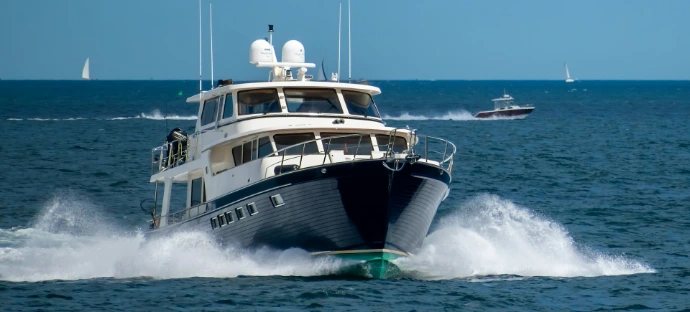
65 to 80 ft
Sportfish, flybridge yachts and long-range trawlers. Twin shafts or pods.
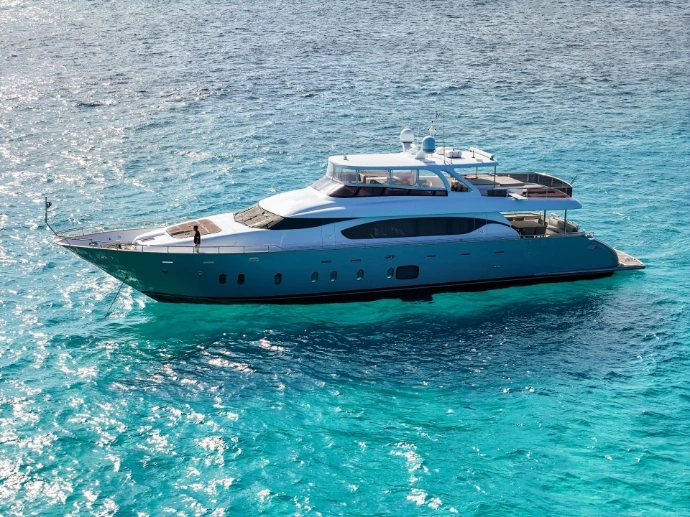
80 to 100 ft
Raised-pilothouse and tri-deck motor yachts. Twin shafts or pods, more hull to cover.
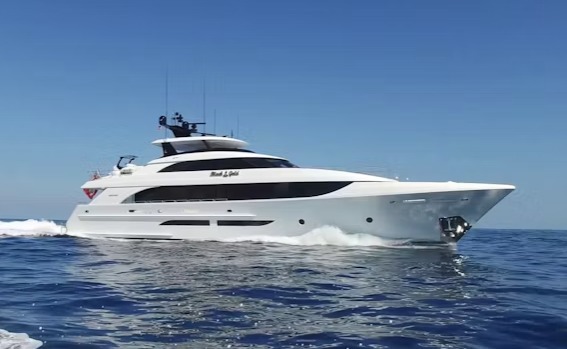
100 to 140 ft
Tri-deck and full-displacement yachts. Twin shafts or large pods, plus sea chests and stabilizers.
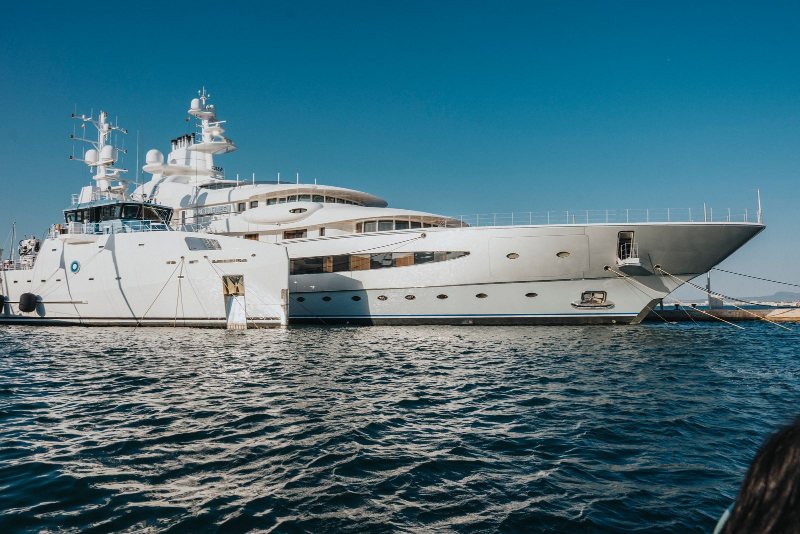
140 ft and up
Superyachts, expedition yachts, and support vessels. Multiple sea chests, box coolers and stabilizers alongside running gear.
Describe the yacht. See the Hull Shield® setup.
A starting layout. Every HDY system is finalized from Hull Shield’s expertise and drawings, but this shows how zones, transducers and controller sizes add up.
Typical configurations cover the hull and running gear. A sea chest, thrusters and stabilizer fins add transducers; toggle them above. Box coolers are specified separately on vessels over 200 ft. A starting layout, not a quote.
High-energy protection where traditional antifouling falls short.
By targeting both large external structures and confined internal systems, HDY covers the entire underwater profile of the vessel.
Hulls
Large hull structures are protected by a strategically distributed array of high-power transducers. With HDY output, fewer units achieve full coverage on vessels over 65 ft, delivering broad, consistent protection across the submerged structure.
Shafts and props
Fouling on shafts and propellers hurts fuel efficiency and propulsion. HDY delivers ultrasonic energy directly through the shaft, protecting shaft and propeller together and keeping running surfaces clean and efficient.
Pod drives
Fouled pods lose thrust, steering response and fuel economy. HDY is highly effective on high-mass IPS and ZF pod structures, maintaining performance, manoeuvrability and handling.
Jet drives
Internal fouling in jet drives is hard to reach and costly to fix. HDY is deployed with non-intrusive installation, reducing buildup and maintenance downtime.
Steering and control gear
Rudders, stabilizers, trim tabs and other control surfaces benefit from targeted protection. Clean control surfaces mean better hydrodynamic efficiency and more responsive, safer handling.
Sea chests
Fouling in sea chests and strainers restricts flow and cuts cooling efficiency. HDY excels in these confined, high-risk areas, maintaining cooling performance and reducing unplanned maintenance.
Pipework, valves and A/C systems
Fouling affects flow rate and valve function. Targeted ultrasound reduces fouling in pipes, manifolds and air-conditioning seawater systems, and lengthens maintenance intervals.
Commercial-grade architecture and modular reliability
HDY is built on the same commercial-series architecture used in Hull Shield’s industrial and workboat systems. Each system uses a modular, multi-channel design with power and control distributed across independent channels.
Because each channel operates independently, protection is maintained even when one needs service. The remaining channels continue normally across the hull, running gear and seawater systems. This service-friendly modularity matches shipyard, OEM and fleet expectations.
Protecting your assets
Owners, operators and shipyards know that maintenance, downtime and operating cost grow with vessel size and complexity. HDY adds a powerful, non-intrusive layer of protection that safeguards critical underwater and seawater-system components and supports long-term asset preservation.
Operating 24/7, HDY provides continuous, non-chemical ultrasonic antifouling protection designed to complement existing bottom coatings, help reduce marine growth, and extend maintenance intervals.
Sustainable, continuous protection
By preventing biofouling before it takes hold, HDY reduces fuel consumption, emissions and reliance on traditional antifouling. Used alongside modern bottom paints it extends coating life and reduces dry-docking frequency, without adding toxins to the marine environment.
Ideally suited for: motor yachts, long-range cruisers and large sailing yachts from 65 ft; vessels with large pods, large propellers and shafts, or complex hull geometry; owners and captains who want maximum protection with minimal maintenance; shipyards and professional installers who value clean system integration.
HD, HDi and HDY side by side.
| Series | Power per transducer | Typical use case | Key advantage |
|---|---|---|---|
| HD (legacy) | Standard output | 20 to 50 ft | Proven reliability |
| HDi (next generation) | +100% vs HD | 30 to 80 ft | Intelligent control and optimization |
| HDY (high power) | +230% vs HD | 65 to 150 ft and beyond | Maximum antifouling performance |
HDY represents the pinnacle of ultrasonic antifouling for the recreational and yacht market: commercial-grade power, broader coverage, cleaner installations and professional-level robustness, engineered for owners, captains, installers and shipyards who demand uncompromising performance.
Numbers are only half the story
Any vendor can print a power rating. Hull Shield’s are backed by the builders who fit the systems, the yachts running them and the haul-out photos to show for it. Ask every vendor for the same. Many systems on the market still run legacy-generation electronics that simply do not compare. Ask what each one delivers, sustained, at the hull.
Six controllers. Two to ten channels.
Every controller ships with 10 m of shielded signal cable per channel, supplied on a spool and cut to each run. HDY-2, HDY-3 and HDY-4 work as add-on controllers for sea chests, thrusters or stabilizers alongside a larger unit, or on their own for smaller specialised installations.
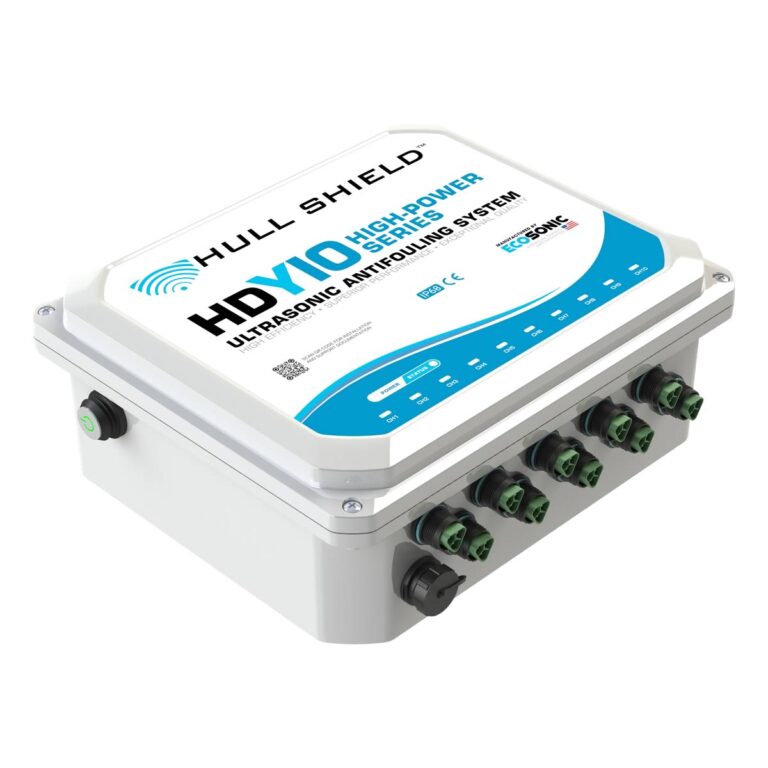
HDY-10 10 channels
Control up to 10 transducers. Includes 100 m of signal cable.
Average Power Draw 50 W (2.1 A at 24 V)
Dimensions 11.24 x 13.74 x 5.72 in
Weight 9.54 lb (4.33 kg)
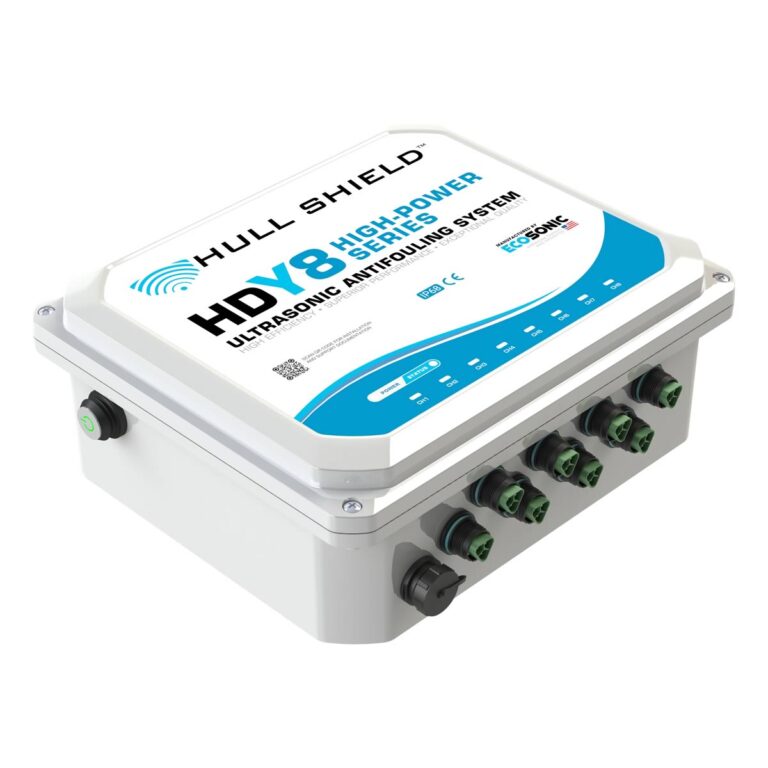
HDY-8 8 channels
Control up to 8 transducers. Includes 80 m of signal cable.
Average Power Draw 40 W (1.67 A at 24 V)
Dimensions 11.24 x 13.74 x 5.72 in
Weight 9.04 lb (4.1 kg)
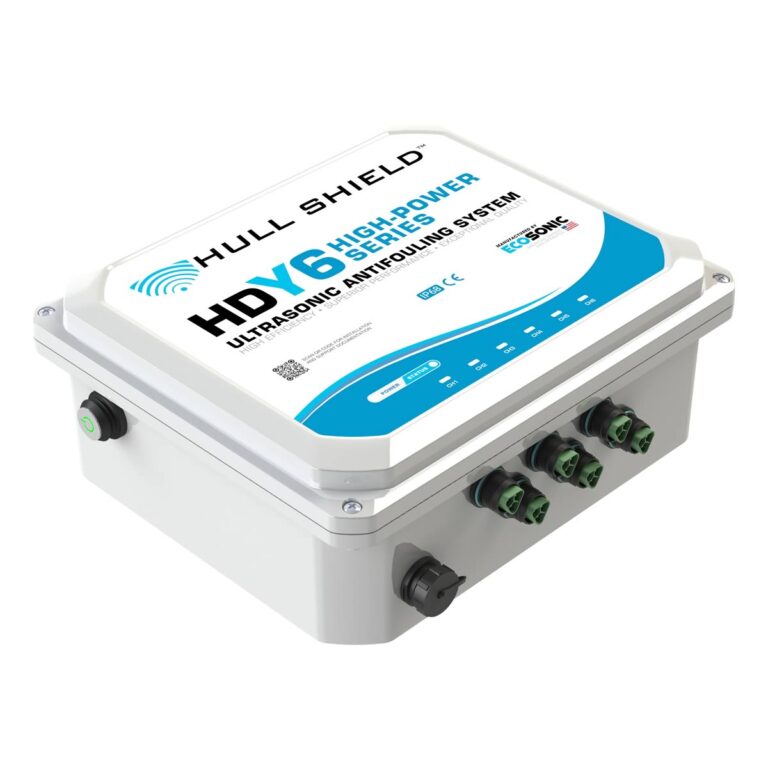
HDY-6 6 channels
Control up to 6 transducers. Includes 60 m of signal cable.
Average Power Draw 30 W (1.25 A at 24 V)
Dimensions 11.24 x 13.74 x 5.72 in
Weight 8.54 lb (3.87 kg)
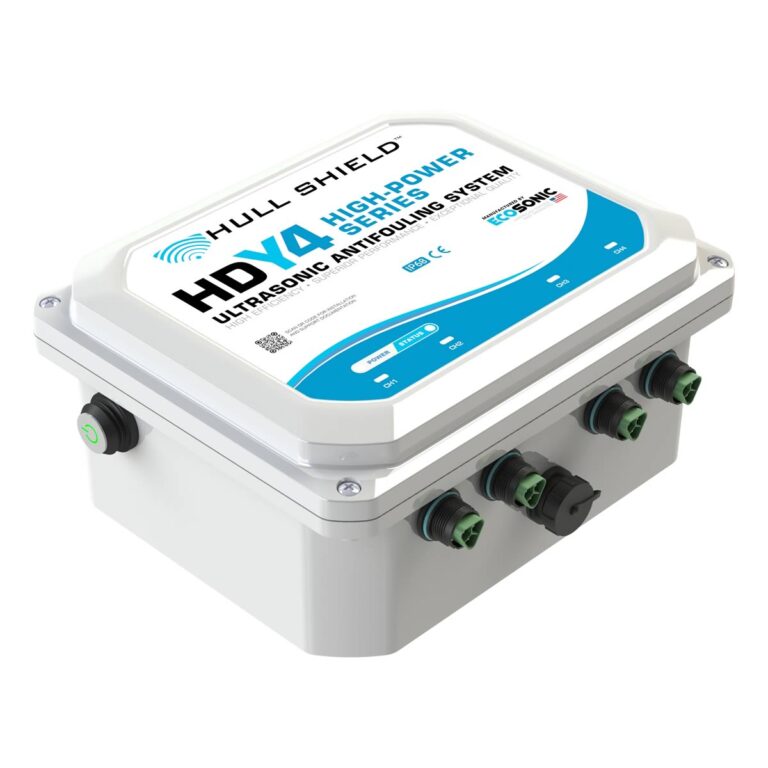
HDY-4 4 channels
Control up to 4 transducers. Includes 40 m of signal cable.
Average Power Draw 20 W (0.84 A at 24 V)
Dimensions 9.04 x 11.04 x 3.72 in
Weight 6.17 lb (2.79 kg)
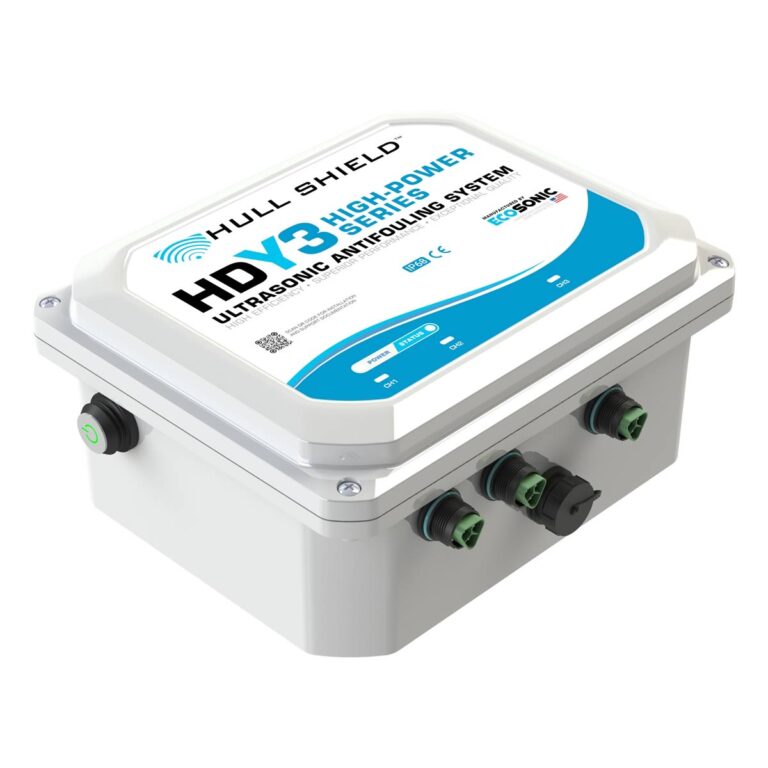
HDY-3 3 channels
Control up to 3 transducers. Includes 30 m of signal cable.
Average Power Draw 15 W (0.63 A at 24 V)
Dimensions 9.04 x 11.04 x 3.72 in
Weight 5.89 lb (2.67 kg)
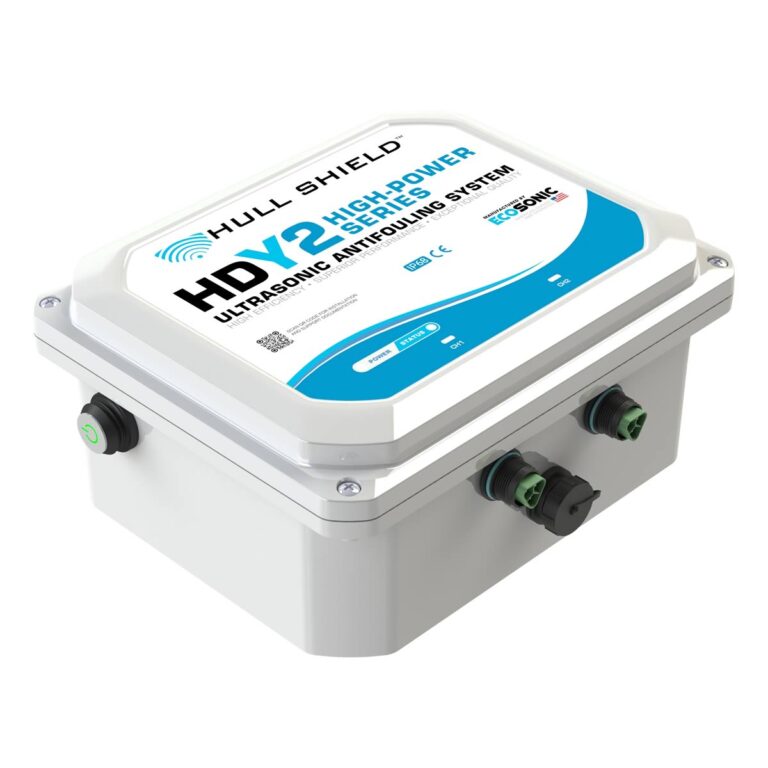
HDY-2 2 channels
Control up to 2 transducers. Includes 20 m of signal cable.
Average Power Draw 10 W (0.42 A at 24 V)
Dimensions 7.04 x 9.04 x 5.22 in
Weight 5.67 lb (2.57 kg)
The figures an engineer asks for.
| Operating characteristics | |
|---|---|
| Maximum input voltage (DC) | 32.0 V |
| Operating voltage range (DC) | 24.0 V to 28.0 V |
| Output voltage range (VAC) | 230 V to 280 V (RMS) |
| Operating temperature | -22 F to 140 F (-30 C to 60 C) |
| Frequency and pulse | |
|---|---|
| Frequency range | 22,727 Hz to 41,666 Hz |
| Maximum sustained pulse power | 100 W per transducer |
| Peak pulse power (under 1 ms) | Proprietary, not disclosed at this time |
| Duty | Pulse, discontinuous load. Variable customizable duty. |
| Ratings | |
|---|---|
| Enclosure | IP68, NEMA 6P and 12, UL94 V-0, UL746C 5VA |
| Signal connectors | IP67, IP68, UL94 V-0 |
| Rocker switch | IP67, RoHS-3 |
| Power and auxiliary cable | UL2464, VW-1, 80 C, RoHS |
How can a controller draw 50 W and deliver 100 W per transducer? Because the transducers pulse rather than run continuously. Each ultrasonic pulse carries up to 100 W to the transducer, but the pulse lasts a small fraction of each cycle, so averaged over time the whole controller takes only 50 W from the vessel’s DC supply. That is why the two figures measure different things: Average Power Draw is the time-averaged load to size batteries and breakers against, sustained pulse power is the output inside each pulse, and peak pulse power is the brief maximum within it, under a millisecond. Comparisons on this page use the sustained figure.
Savings start with fuel. Then divers and haul-outs.
A fouled hull burns more diesel at every speed, and at today’s diesel prices that is the biggest line on the bill. Put in your own numbers. The defaults are examples for an 80 ft twin-diesel yacht kept in warm water, not Hull Shield figures.
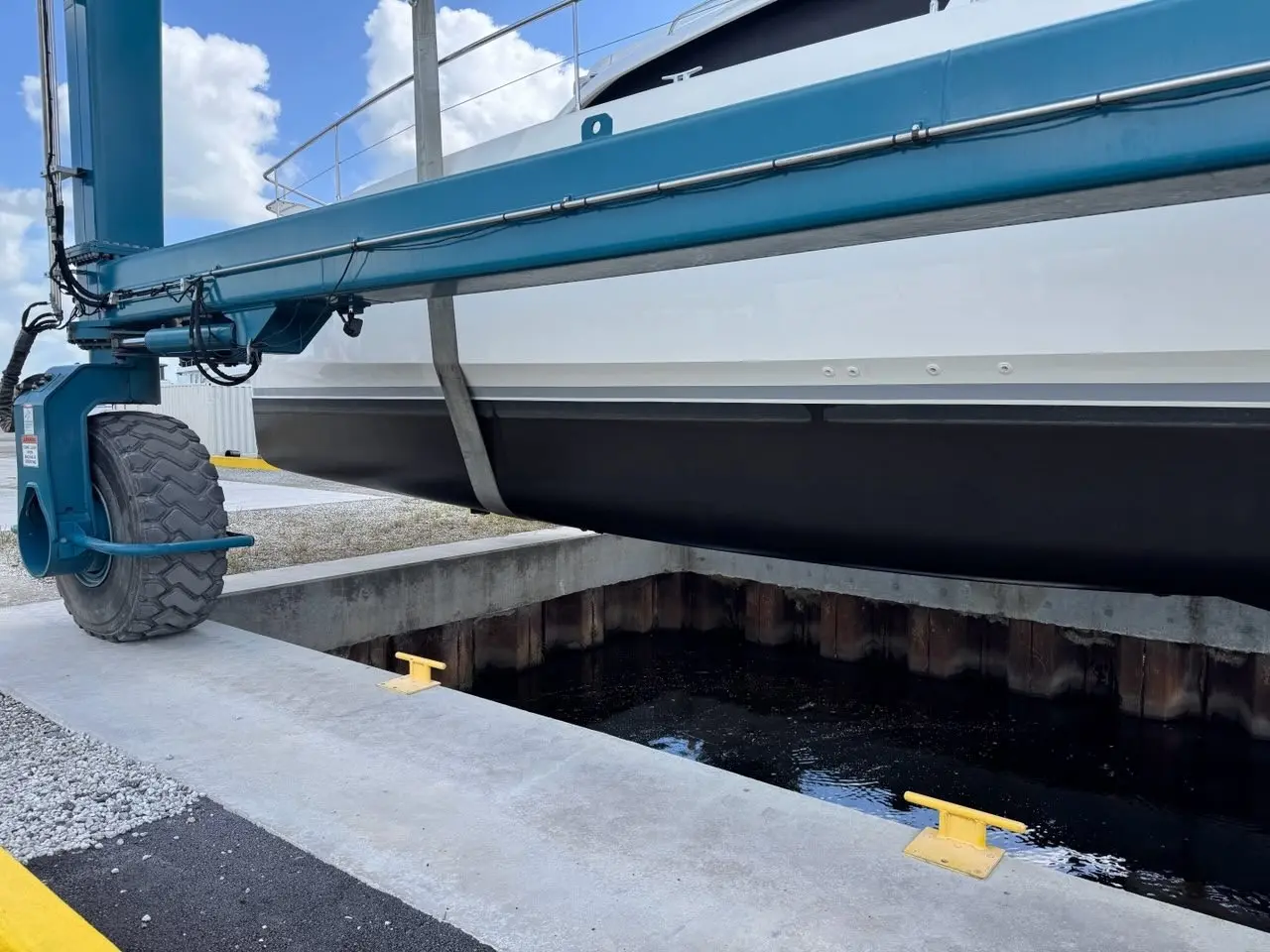
A year in the water, then the lift.
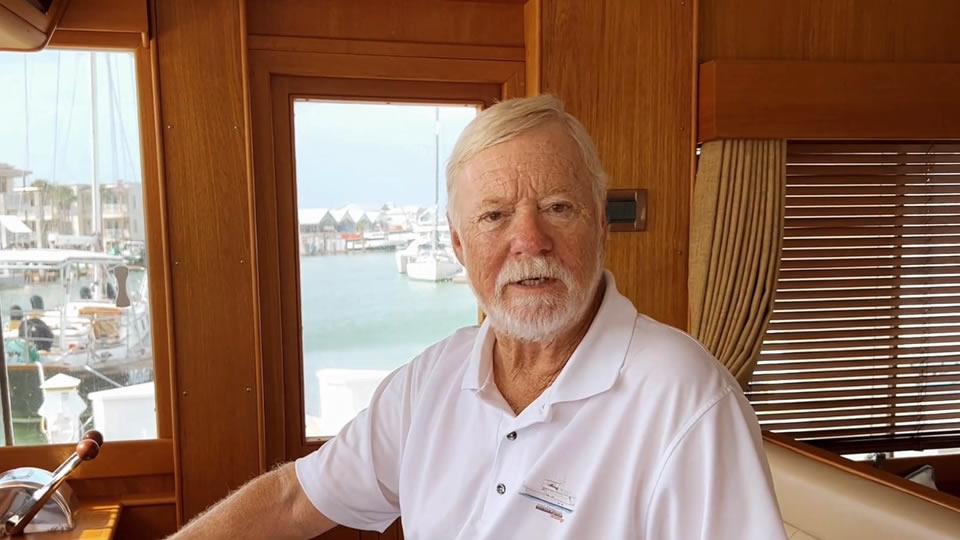
“I have a 50 foot Absolute in Charleston. I used to have a diver come and remove barnacles twice a month. I was skeptical but it really works.”
John T
Absolute 50, Charleston, SC
First HDY field inspections: winter 2026–2027
HDY launched in late 2025 and the first yachts running it come out of the water this winter. Inspection photos and owner results will be posted here as they happen.
Locke Bryan
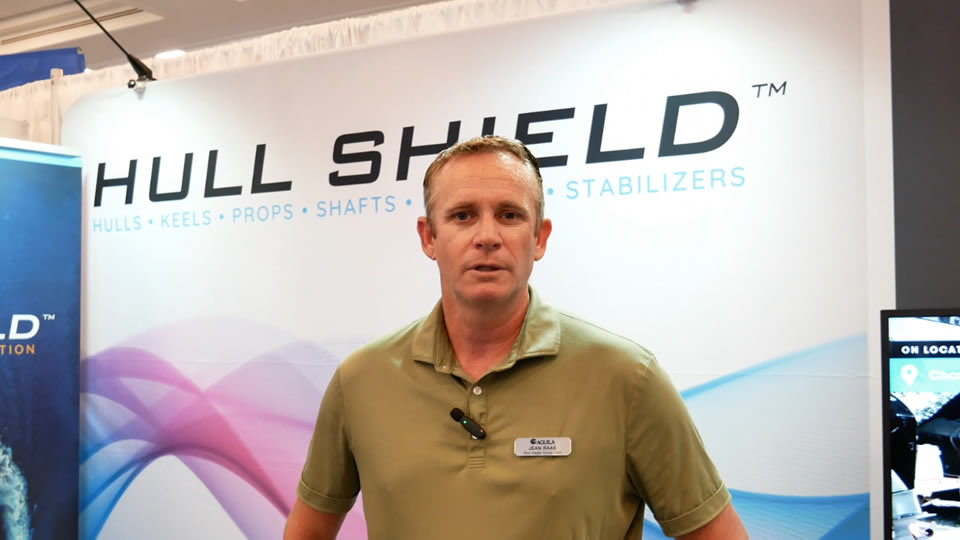
Jean Raas
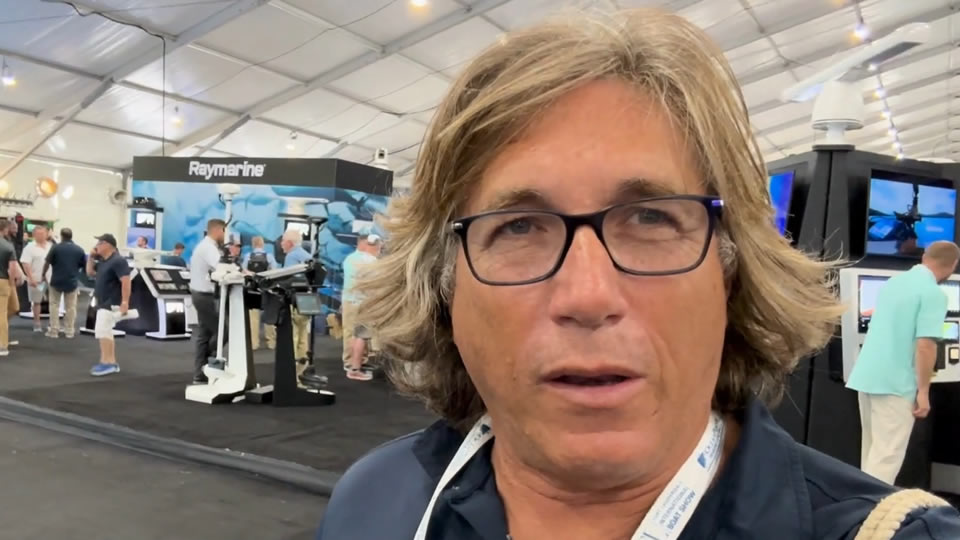
Brett Ribotsky
Tell us about your yacht.
Send your project details and we will survey your requirements and recommend an optimal configuration: a transducer location map, transducer and controller count, and pricing, quoted through a dealer or directly from Hull Shield. We reply within one business day.
- +1 410-999-0219
- info@hullshield.net
- Annapolis, Maryland
- Monday to Friday, 9am to 5pm EST
Drawings or photos can be attached in our reply email.
HDY, answered.
How many transducers does my yacht need?
As a starting point: a 65 to 80 ft yacht typically takes about 10 transducers on one HDY-10, an 80 to 100 ft yacht 14 to 16, a 100 to 140 ft yacht 20 to 26, and 140 ft and up 28 or more across three or more controllers. Sea chests, thrusters and stabilizers add to the count. Every HDY system is finalized from the vessel’s drawings and Hull Shield’s experience. With several thousand vessels already fitted, we know the right setup for most hulls, and the sizing tool on this page gives a first layout in a few clicks.
Does HDY replace bottom paint?
No. HDY provides continuous, non-chemical ultrasonic antifouling protection designed to complement existing bottom coatings, help reduce marine growth and extend maintenance intervals. Customers commonly report gaining a year, sometimes two, between bottom painting intervals.
How can a controller draw 50 W and deliver 100 W per transducer?
Because the transducers pulse rather than run continuously. Each ultrasonic pulse carries up to 100 W to the transducer, but the pulse lasts a small fraction of each cycle, so averaged over time the whole controller takes only 50 W from the vessel’s DC supply. Average Power Draw is the figure to size batteries and breakers against; sustained pulse power is the output inside each pulse.
What does HDY protect besides the hull?
Propellers, shafts and rudders, IPS, Zeus and ZF pod drives, jet drives, stabilizers and other control gear, sea chests and strainers, seawater pipework and air-conditioning seawater systems. Box coolers are specified separately on vessels over 200 ft.
What comes with each controller?
Every controller ships with 10 m of shielded signal cable per channel, supplied on a spool and cut to each run by the installer. Controllers run from 2 to 10 channels: HDY-2, HDY-3 and HDY-4 serve as add-on units for sea chests, thrusters or stabilizers or for smaller specialised installations, and HDY-6, HDY-8 and HDY-10 cover the hull and running gear.
How do I get a quote?
Send your project details through the form on this page. Hull Shield reviews your details and recommends an optimal configuration, a transducer location map, transducer and controller count, and pricing, quoted through a dealer or directly from Hull Shield. We reply within one business day.